
This is the first decline since June this year when car sales declined by 11%.
Sensex ended up 190 points at 25,519 and Nifty climbed 57 points to end at 7,626.

Senior Tesla executives including those from its supply chain are planning to come to India on Wednesday and Thursday for meetings with government officials, including those in the Prime Minister's Office, according to sources. Prashant R Menon, director of Tesla India, did not respond to a specific query on the meetings. Sources say that the executives are coming to see how they can expand and develop local sourcing of components from India for the Tesla car.
While sales of compact cars, including models such as Swift, Celerio, Ignis, Baleno and Dzire declined, sales of utility vehicles, including Vitara Brezza, S-Cross and Ertiga, increased 26.3 per cent to 19,177 units as compared to 15,178 in the year-ago month.

Among the Sensex firms, Infosys, Tata Motors, HDFC Bank, Asian Paints, Tech Mahindra, HDFC, Tata Consultancy Services, Sun Pharma and ICICI Bank were the biggest winners. On the other hand, PowerGrid, NTPC, Nestle, UltraTech Cement, State Bank of India and ITC were among the laggards.
Bajaj Finance was the top gainer in the Sensex pack, rising around 2 per cent, followed by Sun Pharma, Tech Mahindra, Axis Bank, Bajaj Auto and Infosys. NSE Nifty rose 76.40 points to 15,174.80.

Mahindra and Mahindra was the top gainer in the Sensex pack, surging over 16 per cent, followed by Maruti, Titan, Bajaj Finance, HDFC, Bajaj Auto and Hero MotoCorp. On the other hand, HUL, Tech Mahindra, IndusInd Bank and Nestle were the laggards.

Driven by strong demand, the overall passenger vehicle dispatches crossed 3.35 lakh units in February as automakers, including Maruti Suzuki India, Hyundai, Tata Motors and Mahindra & Mahindra, reported robust sales during the month. The dispatches of more than 3.35 lakh units last month marked an 11 per cent over February 2022. It was also the highest ever overall wholesales in the month of February. The country's largest carmaker Maruti Suzuki India on Wednesday said its domestic wholesales rose 11 per cent to 155,114 units in February as compared with 140,035 units in the same month last year.

Benchmark BSE Sensex rose by over 379 points on Tuesday as gains in oil & gas, banking and auto shares helped the barometer continue winning run for the third straight session. The 30-share BSE benchmark index advanced 379.43 points or 0.64 per cent to settle at 59,842.21. During the day, it jumped 460.25 points or 0.77 per cent to 59,923.03. The broader NSE Nifty climbed 127.10 points or 0.72 per cent to 17,825.25 as 42 of its constituents advanced.

The strong domestic growth for new vehicle sales during 2008-12, which witnessed a compounded annual growth rate of 14 per cent, led to an increased inventory of used cars, thanks to trade-ins.

Tech Mahindra was the top gainer in the Sensex pack, rising around 4 per cent, followed by HDFC, Infosys, Bajaj Finserv, Asian Paints and Bajaj Finance. Nifty rose 229.15 points to 18,102.75.
On the Sensex chart, NTPC, Bajaj Auto, Tech Mahindra, ONGC and Maruti were among the major gainers.

The country saw a massive year-on-year surge in the demand for electric vehicles, with retail sales of electric two-wheelers rising by 58 per cent, passenger vehicles by 130 per cent, three-wheelers by 82 per cent, and commercial vehicles by 171 per cent in March 2023, according to the data shared by the Federation of Automobile Dealers Associations (Fada). According to a report by JMK Research, the EV segment as a whole grew by 157 per cent during FY23, to 1,180,597 units, from 458,746 units a year ago. Overall, EV sales in March 2023 rose by 82 per cent from the March 2022 figure, the JMK report added.
Nearly two million e-mandates for recurring payments have been registered with banks and card networks after the Reserve Bank of India (RBI) made it mandatory from October 1 to take prior consent of a customer before debiting her account, sources in know of the matter said. Industry estimates peg the recurring transactions at approximately 2.5 per cent of the total volume of transactions, and about 1.5 per cent in terms of value. Of these, around 75 per cent of domestic recurring transactions, and about 85 per cent international recurring payments are below Rs 5,000.

From the 30-share pack, Indusind Bank, Axis Bank, Maruti Suzuki, Bajaj Finance, Bajaj Finserv, UltraTech Cement and Mahindra & Mahindra were the biggest drags, tumbling up to 7.63 per cent.

Within hours of rate cut announced by RBI, United Bank has reduced the benchmark lending rate by 0.25 per cent, while other banks including market leader SBI have indicated that they would follow suit.

The sharp correction in the Indian markets from their peak levels has made valuations attractive, say analysts, who advise buying selectively, but only from a long-term perspective. Fifty-six of the Nifty 100 stocks, according to Mahesh Nandurkar, managing director at Jefferies, now trade below the 10-year historical averages, including stocks in financial, select auto, and pharma sectors. "Valuation (one-year forward consensus price-to-earnings, PE) has declined 25 per cent from October 2021 peak, almost matching the 33 per cent price-earnings contraction during the 2011 tightening cycle when repo rates went up by 375 basis points (bps) versus 250 bps this cycle.

Consumer stocks remain the biggest laggard on the bourses. The Nify50 weighting of FMCG stocks declined to a decade low of 9.9 per cent at the end of March this year, down 150 basis points from 11.4 per cent a year ago. At their peak in March 2013, major FMCG stocks, such as Hindustan Unilever, ITC, and Asian Paints, together accounted for 15 per cent of the Nifty50. But now together with automobile stocks, the consumer goods sector accounts for only 14.7 per cent of the index, down 200 basis points in the past 12 months and 37 per cent from the record high weighting of 23.4 per cent at the end of March 2014.

Bajaj Auto was the top loser in the Sensex pack, shedding around 2 per cent, followed by TCS, HDFC Bank, Axis Bank, Reliance Industries and Tech Mahindra. On the other hand, Tata Steel, Bajaj Finserv, Bharti Airtel and NTPC were among the gainers. NSE Nifty dropped 38.10 points to close at 15,689.80.

Market linking of petrol and diesel prices has helped the industry.

Even as India's passenger-vehicle sales touched a record high of 3.9 million units in 2022-23, growing 27 per cent over the previous financial year, the country's largest carmaker, Maruti Suzuki India (MSIL), said on Monday uncertainties in the electronic-component supplies might affect production in FY24. MSIL said the shortage of electronic components had some impact on production in FY23. "The company took all possible measures to minimise the impact.

While hybrids, CNG and biofuels found favour in 2018 among many carmakers including Maruti Suzuki, Mercedes-Benz, Toyota and Honda, others such as M&M and Tata Motors have shown full faith in electric vehicles.

The global semiconductor shortage hit passenger vehicle sales in September, with major manufacturers like Maruti Suzuki, Hyundai and Mahindra & Mahindra reporting a decline in sales on Friday. Kia India and Honda Cars also reported a dip in wholesales last month as compared with the year-ago period. Carmakers like Tata Motors, Toyota Kirloskar Motor, Nissan and Skoda, however, reported an increase in passenger vehicle dispatches last month despite supply chain issues.

IndusInd Bank was the biggest loser in the Sensex pack, shedding 7.46 per cent, followed by SBI, Tata Motors, M&M, Bajaj Finserv, Axis Bank and Infosys. In contrast, Tech Mahindra was the only winner.

Investors' wealth eroded by Rs 3.46 lakh crore on Wednesday as equity markets took a sharp tumble amid weak global trends and foreign fund outflows. The 30-share BSE Sensex fell by 676.53 points or 1.02 per cent to settle at 65,782.78. During the day, it plunged 1,027.63 points or 1.54 per cent to 65,431.68. In line with the weak trend in equities, the market capitalisation of BSE-listed firms eroded by Rs 3,46,947.54 crore to Rs 3,03,33,258.69 crore.

Maruti was the top gainer in the Sensex pack, rallying over 6 per cent, followed by M&M, Bajaj Auto, NTPC, Reliance Industries and HDFC Bank. NSE Nifty advanced 1.90 points to record 17,855.10.

The Adani Group led in adding net fixed assets, which are up more than 90 per cent since September 2019 or before COVID-19.

Maruti Suzuki, riding on the success of models like Swift, Estillo and Dzire, posted a growth of 3.4 per cent over the same period in the previous fiscal.

The BSE Sensex maintained its winning run for the fourth session on the trot on Wednesday to reclaim the 60,000-level after a gap of over four months as investors remained upbeat amid softening crude oil prices and persistent foreign fund inflows. A strengthening rupee and positive Asian markets further bolstered sentiment, traders said. The 30-share BSE benchmark jumped 417.92 points or 0.70 per cent to settle at 60,260.13 -- closing above the psychologically key 60,000-mark for the first time since April 5 this year.

The Warren Buffet-backed Chinese electric vehicle manufacturer BYD will be unveiling a Born Electric SUV for the Indian market by the fourth quarter of the current calendar year. The deliveries of the same would begin in January, the company's top official said. This will be the first Born Electric SUV in the mass market. The Born Electric models from Tata Motors and Mahindra and Mahindra would be launched from 2024. BYD has been selling the E6 MPV in the Indian market since 2021.

Investors' wealth jumped Rs 2,93,054.25 crore on Thursday as markets returned to winning ways after falling for three straight sessions. The 30-share BSE benchmark Sensex zoomed 638.70 points or 1.22 per cent to close at 52,837.21. During the day, it gained 668.75 points to 52,867.26. Tracking the bullish trend, the market capitalisation of BSE-listed companies jumped Rs 2,93,054.25 crore to reach Rs 2,33,94,917.25 crore.

Among Sensex stocks, Maruti rose the most, followed by Tech Mahindra, Mahindra & Mahindra and Asian Paints. Gains in Reliance, TCS, Infosys, HCL Tech, HDFC and ICICI Bank also helped the barometer extend its rally for a second day.

The limited availability of flexible (flex)-fuel vehicles in the Indian market and the slow rollout of ethanol-blended petrol by oil-marketing companies (OMCs) remain major obstacles to achieving widespread use of biofuels in the transportation sector in India. Recently, two Union ministers have emphasised India's biofuel potential, arguing that it has the capacity and potential to lead a transition towards widespread biofuel adoption. Road Transport Minister Nitin Gadkari signalled that this transition is well underway and urged car manufacturers to quickly adapt and introduce new biofuel-run vehicles, lest the government resort to taxing diesel vehicles.

Infosys was the top gainer in the Sensex pack, jumping over 4 per cent, followed by Tech Mahindra, Tata Steel, ICICI Bank, ITC, Maruti, SBI and Axis Bank. On the other hand, HCL Tech, M&M, Dr Reddy's, Asian Paints, Bajaj Auto and Bharti Airtel were among the laggards.
Titan was the top gainer in the Sensex pack, rallying over 5 per cent, followed by Bajaj Auto, Bajaj Finserv, SBI, Nestle India, ITC, Axis Bank and Tata Steel. Nifty rose 46 points to its fresh closing peak of 17,991.95.

Continuing its decline for the third day on Friday, the BSE gauge plummeted 1,214.96 points or 2.20 per cent to 53,887.72 during the day. It settled at 54,333.81, a decline of 768.87 points or 1.40 per cent.
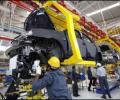
The issues unions have been pursuing aggressively include forced suspensions, flexible work conditions, recognition of a union and salary parity for contract workers.

Both are finding it difficult to sell one each of their plants -- Chennai Maraimalai Nagar (Ford) and Talegaon near Pune (GM) -- and are finding the road blocked by employee severance snarl-ups, report Sohini Das and Shine Jacob.

About two dozen car & SUV models and two-wheelers lined up for launch

Powered by a rally in index heavyweight Reliance Industries, equity benchmark Sensex broke its four-session losing run to close above the 55,000-mark on Thursday despite a weak trend overseas. Investors made a cautious return to IT, pharma and bank stocks after their recent sell-off. However, a depreciating rupee and persistent foreign fund outflows capped the gains, traders said. Overcoming a lacklustre start, the 30-share BSE Sensex surged 427.79 points or 0.78 per cent to close at 55,320.28.
